
Agrivoltaics: A Pathway to Sustainable Livelihoods and Renewable Energy
Vishwajeet Poojary, Nivedita Cholayil and Shreyas Joshi | Oct 15, 2024, 15:52 IST |

Picture 1- Shreyas Joshi, WRI India
A people-centered approach to agrivoltaics should focus on stakeholder perceptions, skill development, and equitable benefit-sharing mechanisms. This will be crucial to successfully implement agrivoltaics for optimal land-use and to advance India's energy and food security goals while supporting farmers and rural communities.
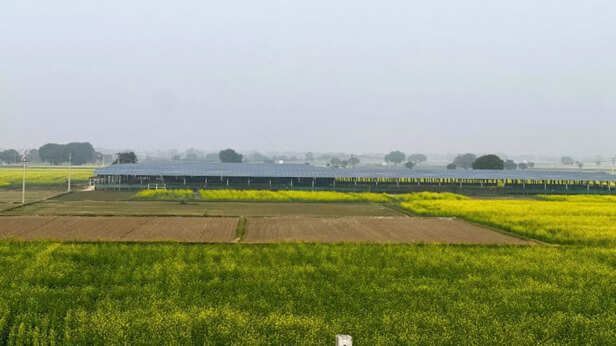
As the first light of dawn breaks, Ravi steps onto his fields to the sight of solar panels glistening in the early morning sun. This is not just any farm; it is an agrivoltaics installation where the land is co-utilized for cultivating crops, raising livestock, and harnessing solar energy.
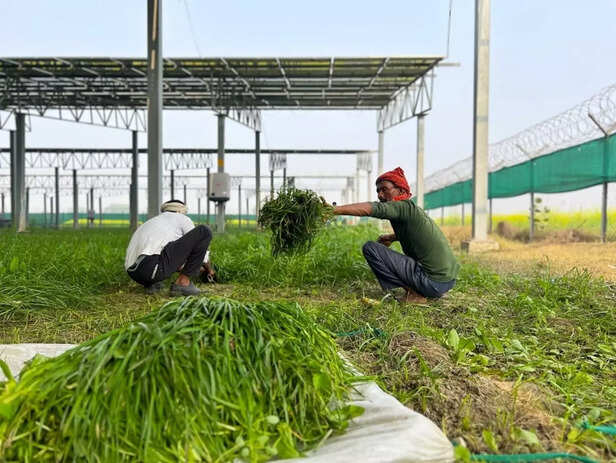
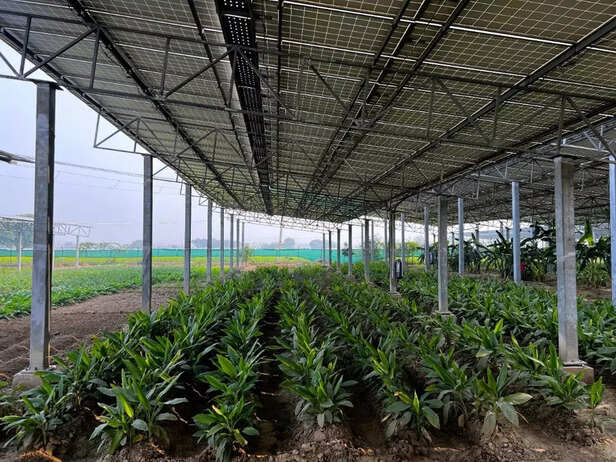
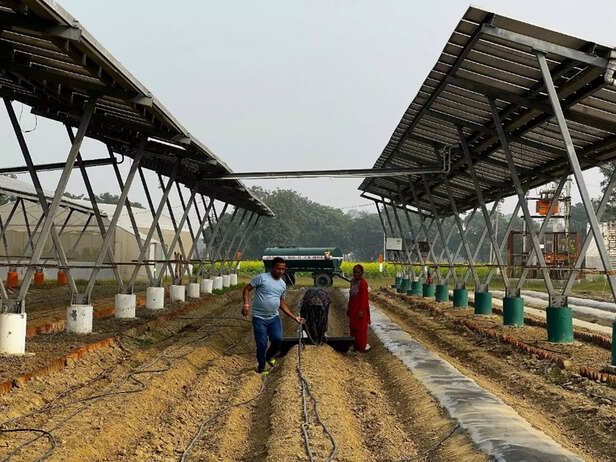
Ravi and his co-worker Rajesh oversee this 2.5 MW solar plant on 3.4 acres of land in Issapur, on the outskirts of New Delhi, by utilizing knowledge and skills gained from their work in agricultural universities. On this farm, they grow a range of horticultural crops, including fruits (like banana and sweet lime), vegetables (like onion, cauliflower, tomato, spinach, and carrot), spices (like turmeric), and livestock feed.
![Picture 2- Shreyas Joshi, WRI India]()
![Picture 3- Vishwajeet Poojary, Asar]()
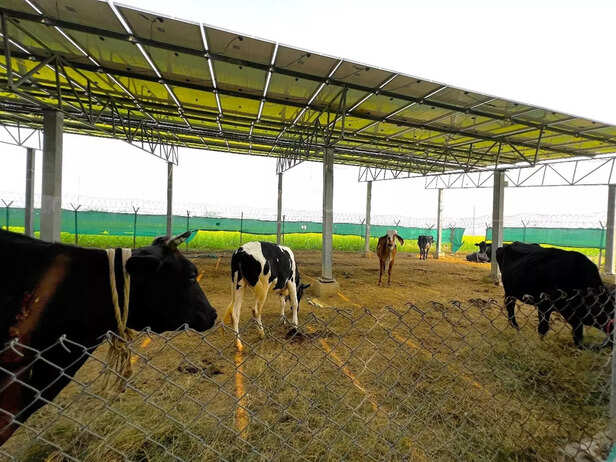
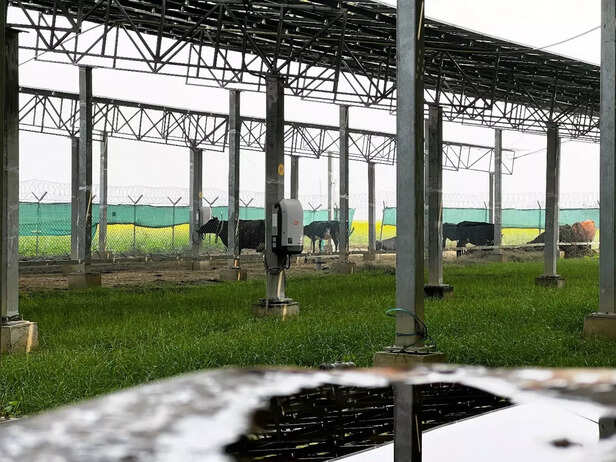
Additionally, the Issapur agrivoltaic plant houses a herd of 8-10 cattle that are reared in a dedicated space under the solar panels and fed grass cultivated within the premises. Solar grazing, as this is called, allows farmers to diversify their income while also generating renewable power.
![Picture 4- Vishwajeet Poojary, Asar]()
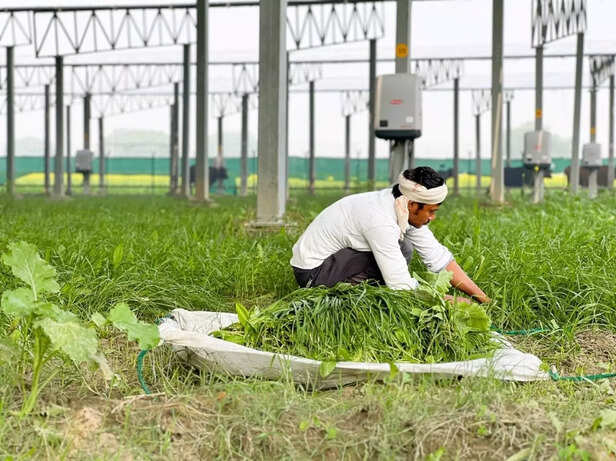
An agrivoltaics plant can create additional employment opportunities for the local community, sometimes supplementing their existing livelihoods. Kuldeep is one such farmer, who cultivates mustard on an adjacent farm, while also working as a labourer on the agrivoltaics plant. He said that the installation has been a boon for agricultural labourers like him, who do not get much work between the sowing and harvesting seasons. The cultivation of various short-term, shade-loving crops at the plant generates a regular demand for agricultural work, offering workers like Kuldeep greater economic opportunities.
“It is good for everyone if farming and solar power generation together can generate income for 2 more families,” says Kuldeep.
![Picture 6- Vishwajeet Poojary, Asar]()
Apart from the four to five workers engaged in farming activities, the plant also employs three to four workers to maintain and operate the solar panels. However, only one of these workers is a woman.
![Picture 7- Shreyas Joshi, WRI India]()
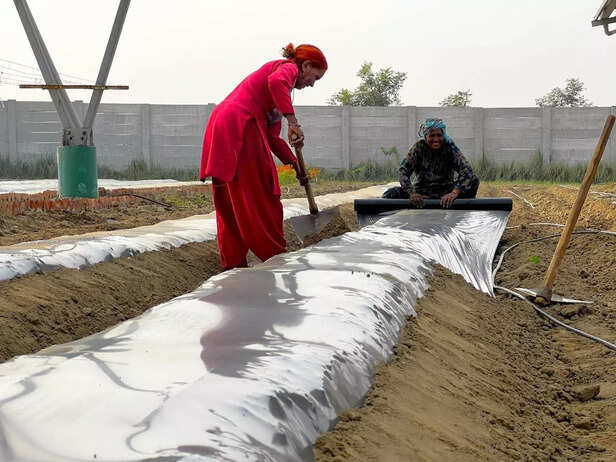
Co-locating solar and agricultural activities has the potential to sustain and improve the livelihoods of many women, particularly since they constitute two-thirds of the agricultural workforce in India (PLFS, 2023). Laxmidevi, who has been with the plant since its inception, lost her previous job at a local factory during the COVID-19 pandemic. The Issapur plant provided her the opportunity to earn a stable income within her village.
![Picture 8- Vishwajeet Poojary, Asar]()
Today, she manages the farm’s livestock and the land surrounding the panels and plays a key role in the day-to-day operations of solar power generation at the plant. She has been trained to assist in the activation of the solar PV system which produces power and feeds it to the grid. In a largely male-dominated space, such initiatives to train women in agrivoltaics can help usher in a more inclusive technological transition. As the technology scales up, providing training to local agricultural workers — especially women — to become solar technicians can contribute to preserving and improving their livelihoods.
In addition to the socio-economic benefits of job creation and livelihood preservation, agrivoltaics can be environmentally beneficial. Shade from the solar panels can increase water use efficiency by reducing the water lost through evaporation, which is particularly advantageous in arid and semi-arid regions. The water used to clean solar panels can be repurposed for irrigation, as seen at the Cochin International Airport agrivoltaic plant.
![Picture 10- CIAL]()
However, setting up an agrivoltaics plant could require changing the crops cultivated and restructuring existing practices and schedules, which requires additional effort and investment.
![Picture 11- Shreyas Joshi, WRI India]()
Mohan, another local farmer, chose not to set up an agrivoltaics plant on his farmland due to the high upfront cost. He was unsure about changing the crop and land use and did not see a clear incentive to change something that was working well. This is where agriculture extension centres or Krishi Vigyan Kendras (KVKs) can play a pivotal role.
![Picture 12- Vishwajeet Poojary, Asar]()
For example, the KVK at Ujwa village in Delhi has a pilot-scale demonstration unit that provides scientific evidence to farmers on the benefits and practical challenges of agrivoltaics.
![Picture 13- Shreyas Joshi, WRI India]()
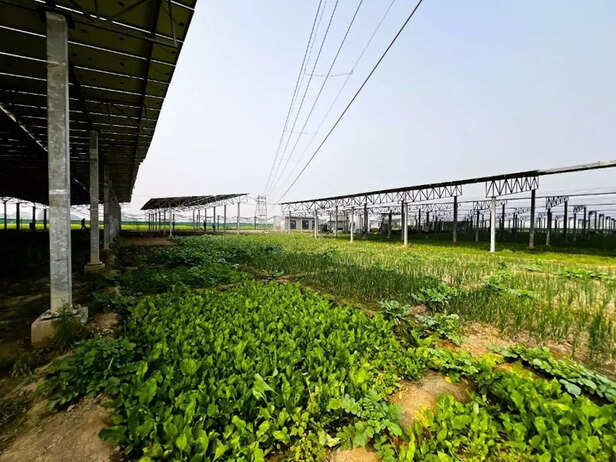
In Amrol, Gujarat, Prof. Mevada’s team from Anand Agricultural University has successfully cultivated more than 30 varieties of crops, including cereals, pulses, and oilseeds, at their 1 MW plant. Effective dissemination of findings from existing and upcoming pilot installations across different agro-ecological zones will help farmers make informed decisions about adopting agrivoltaics.
![Picture 14- Vishwajeet Poojary, Asar]()
![Picture 15- Shreyas Joshi, WRI India]()
Cases like Issapur and the stories of its workers can be useful for farmers and developers exploring agrivoltaics across the country. More importantly, achieving a just and equitable transition to low-carbon technologies requires dedicated supportive policies on shared land use for agriculture and solar PV.
![Picture 16- Shreyas Joshi, WRI India]()
At present, the only policy framework guiding farmers to install solar plants on their agricultural land is the scheme that supports the solarization of rural and agricultural feeders. Smaller and marginal farmers who are already in financial distress might get left behind during the scaling-up process due to the high upfront investment and the fixed nature of the installation. Moreover, agrivoltaics are suitable only for certain land and crop types, thereby excluding landowners whose land and soil characteristics do not align with these requirements. There is a need for detailed and clearly defined standards and regulations. These regulations must be informed not just by learnings from entities like Krishi Vigyan Kendras, academic institutions, and solar developers, but also by insights from farmers and workers who are directly affected.
![Picture 17- Shreyas Joshi, WRI India]()
A people-centered approach must account for the perceptions, preferences, and priorities of key stakeholders, particularly farmers and local communities, who may need support to make the most of the transition. This support should also include the development of a diverse set of skills to implement and maintain agrivoltaic systems. Furthermore, highlighting farmers’ experiences and incorporating their values and concerns in project planning and regulation will be key to developing agrivoltaics in a just and equitable manner. Exploring financial and benefit-sharing mechanisms, such as the possibility of pooling land and resources for agrivoltaics is another way to ensure the accessibility of agrivoltaics to farmers of all classes and an equitable distribution of its benefits.
Agrivoltaics presents an opportunity to optimize land use and reimagine the food-energy-water nexus. However, its success lies not only in the technology but in the way it is implemented and the impact it can create on people dependent on land-based livelihoods. By placing the needs of farmers and rural communities at the forefront, agrivoltaics holds the potential to advance India's journey towards achieving both energy and food security equitably.
The names of all the workers mentioned in the photo essay have been changed to ensure their anonymity.
Vishwajeet Poojary is a former Senior Program Associate of WRI India. Nivedita Cholayil is a Senior Program Associate and Shreyas Joshi is a Senior Program Communications Associate with WRI India. Views expressed by the authors in the photo essay are personal.
Ravi and his co-worker Rajesh oversee this 2.5 MW solar plant on 3.4 acres of land in Issapur, on the outskirts of New Delhi, by utilizing knowledge and skills gained from their work in agricultural universities. On this farm, they grow a range of horticultural crops, including fruits (like banana and sweet lime), vegetables (like onion, cauliflower, tomato, spinach, and carrot), spices (like turmeric), and livestock feed.
Picture 2- Shreyas Joshi, WRI India
Picture 3- Vishwajeet Poojary, Asar
Additionally, the Issapur agrivoltaic plant houses a herd of 8-10 cattle that are reared in a dedicated space under the solar panels and fed grass cultivated within the premises. Solar grazing, as this is called, allows farmers to diversify their income while also generating renewable power.
Picture 4- Vishwajeet Poojary, Asar
An agrivoltaics plant can create additional employment opportunities for the local community, sometimes supplementing their existing livelihoods. Kuldeep is one such farmer, who cultivates mustard on an adjacent farm, while also working as a labourer on the agrivoltaics plant. He said that the installation has been a boon for agricultural labourers like him, who do not get much work between the sowing and harvesting seasons. The cultivation of various short-term, shade-loving crops at the plant generates a regular demand for agricultural work, offering workers like Kuldeep greater economic opportunities.
“It is good for everyone if farming and solar power generation together can generate income for 2 more families,” says Kuldeep.
Picture 6- Vishwajeet Poojary, Asar
Apart from the four to five workers engaged in farming activities, the plant also employs three to four workers to maintain and operate the solar panels. However, only one of these workers is a woman.
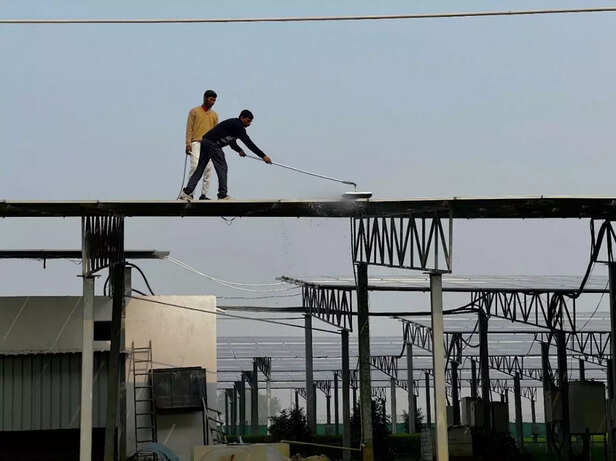
Picture 7- Shreyas Joshi, WRI India
Co-locating solar and agricultural activities has the potential to sustain and improve the livelihoods of many women, particularly since they constitute two-thirds of the agricultural workforce in India (PLFS, 2023). Laxmidevi, who has been with the plant since its inception, lost her previous job at a local factory during the COVID-19 pandemic. The Issapur plant provided her the opportunity to earn a stable income within her village.
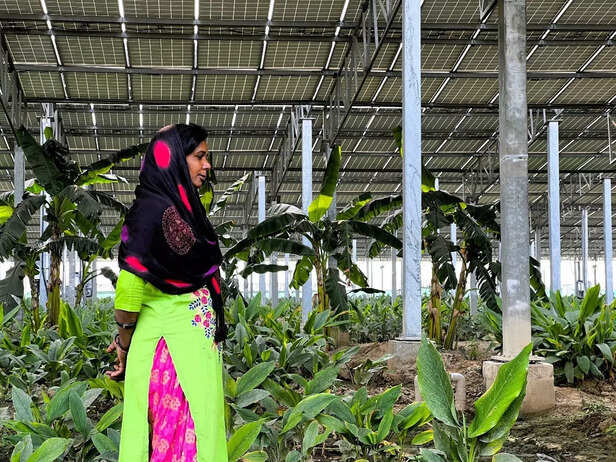
Picture 8- Vishwajeet Poojary, Asar
Today, she manages the farm’s livestock and the land surrounding the panels and plays a key role in the day-to-day operations of solar power generation at the plant. She has been trained to assist in the activation of the solar PV system which produces power and feeds it to the grid. In a largely male-dominated space, such initiatives to train women in agrivoltaics can help usher in a more inclusive technological transition. As the technology scales up, providing training to local agricultural workers — especially women — to become solar technicians can contribute to preserving and improving their livelihoods.
In addition to the socio-economic benefits of job creation and livelihood preservation, agrivoltaics can be environmentally beneficial. Shade from the solar panels can increase water use efficiency by reducing the water lost through evaporation, which is particularly advantageous in arid and semi-arid regions. The water used to clean solar panels can be repurposed for irrigation, as seen at the Cochin International Airport agrivoltaic plant.
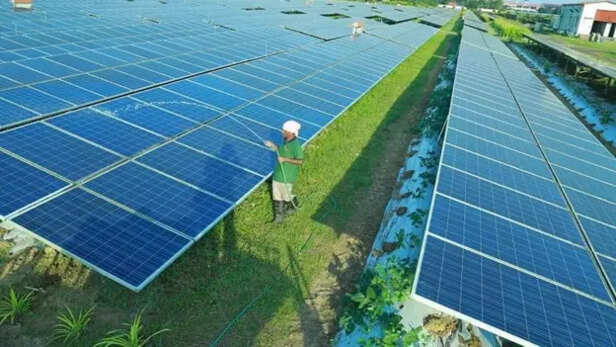
Picture 10- CIAL
However, setting up an agrivoltaics plant could require changing the crops cultivated and restructuring existing practices and schedules, which requires additional effort and investment.
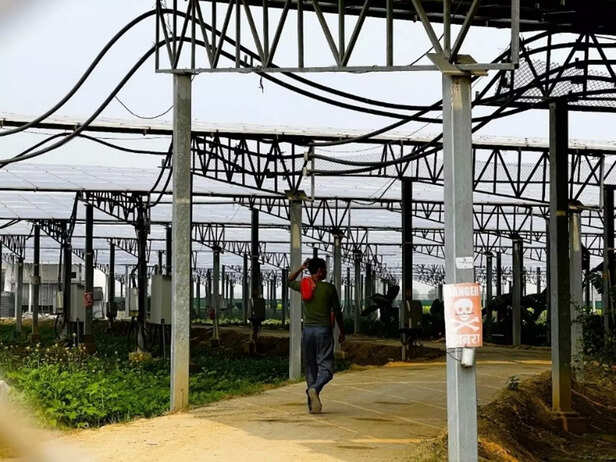
Picture 11- Shreyas Joshi, WRI India
Mohan, another local farmer, chose not to set up an agrivoltaics plant on his farmland due to the high upfront cost. He was unsure about changing the crop and land use and did not see a clear incentive to change something that was working well. This is where agriculture extension centres or Krishi Vigyan Kendras (KVKs) can play a pivotal role.
Picture 12- Vishwajeet Poojary, Asar
For example, the KVK at Ujwa village in Delhi has a pilot-scale demonstration unit that provides scientific evidence to farmers on the benefits and practical challenges of agrivoltaics.
Picture 13- Shreyas Joshi, WRI India
In Amrol, Gujarat, Prof. Mevada’s team from Anand Agricultural University has successfully cultivated more than 30 varieties of crops, including cereals, pulses, and oilseeds, at their 1 MW plant. Effective dissemination of findings from existing and upcoming pilot installations across different agro-ecological zones will help farmers make informed decisions about adopting agrivoltaics.
Picture 14- Vishwajeet Poojary, Asar
Picture 15- Shreyas Joshi, WRI India
Cases like Issapur and the stories of its workers can be useful for farmers and developers exploring agrivoltaics across the country. More importantly, achieving a just and equitable transition to low-carbon technologies requires dedicated supportive policies on shared land use for agriculture and solar PV.
Picture 16- Shreyas Joshi, WRI India
At present, the only policy framework guiding farmers to install solar plants on their agricultural land is the scheme that supports the solarization of rural and agricultural feeders. Smaller and marginal farmers who are already in financial distress might get left behind during the scaling-up process due to the high upfront investment and the fixed nature of the installation. Moreover, agrivoltaics are suitable only for certain land and crop types, thereby excluding landowners whose land and soil characteristics do not align with these requirements. There is a need for detailed and clearly defined standards and regulations. These regulations must be informed not just by learnings from entities like Krishi Vigyan Kendras, academic institutions, and solar developers, but also by insights from farmers and workers who are directly affected.
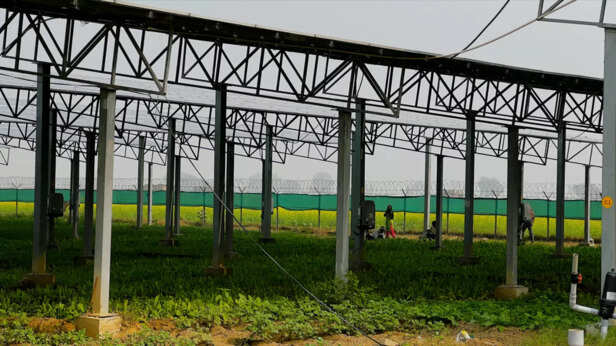
Picture 17- Shreyas Joshi, WRI India
A people-centered approach must account for the perceptions, preferences, and priorities of key stakeholders, particularly farmers and local communities, who may need support to make the most of the transition. This support should also include the development of a diverse set of skills to implement and maintain agrivoltaic systems. Furthermore, highlighting farmers’ experiences and incorporating their values and concerns in project planning and regulation will be key to developing agrivoltaics in a just and equitable manner. Exploring financial and benefit-sharing mechanisms, such as the possibility of pooling land and resources for agrivoltaics is another way to ensure the accessibility of agrivoltaics to farmers of all classes and an equitable distribution of its benefits.
Agrivoltaics presents an opportunity to optimize land use and reimagine the food-energy-water nexus. However, its success lies not only in the technology but in the way it is implemented and the impact it can create on people dependent on land-based livelihoods. By placing the needs of farmers and rural communities at the forefront, agrivoltaics holds the potential to advance India's journey towards achieving both energy and food security equitably.
The names of all the workers mentioned in the photo essay have been changed to ensure their anonymity.
Vishwajeet Poojary is a former Senior Program Associate of WRI India. Nivedita Cholayil is a Senior Program Associate and Shreyas Joshi is a Senior Program Communications Associate with WRI India. Views expressed by the authors in the photo essay are personal.